An
American Opera Queen in London
Ah, England! Land
of bitters, bangers and buggers. Birthplace of such culinary delights
as bubble and squeak and stewed tomatoes! Home to critics whose idea
of a great Mozart soprano is Joan Rodgers! But seriously, my dears,
London is everything wonderful I'd ever heard and more. From afternoon
tea at Harrod's to tomb-gazing at Westminster Abbey, the city won Enzo's
Italianate heart. Of course, visual and performing arts of all kinds
are special attractions. Besides its obvious historical settings, London
is full of associations with things operatic.
Within hours of landing
at Heathrow Airport, I stumbled upon the cluttered excess of the John
Soane museum, which houses the original "Rake's Progress" series by
Hogarth. These paintings, dark, bawdy and haunting in spirit, inspired
Stravinsky's musical setting of the 18th century morality tale. Elsewhere,
I viewed autograph scores by Beethoven, Rossini, Berg and Britten in
the books and manuscripts section of the British museum. Also on view
was the death warrant for Robert Devereux, signed by Elizabeth I (images
of Beverly Sills roughing up Placido Domingo came to mind). At the Theatre
Museum in the Covent Garden district, I saw costumes worn by 18th century
castrati (lots of gold brocade), Swedish nightingale Jenny Lind and
others, as well as playbills for performances featuring legendary 19th
century divas like Pasta, Grisi and Sontag. If you have anything of
the mystic about you, it's hard not to be awed by the visual immediacy
of all this history. I was especially moved while studying Mozart's
original manuscript of his song "Das Veilchen." As I looked at the elegant,
absolutely flawless penmanship, I imagined what it might be like to
stand face to face with the mythic wunderkind.
Covent Garden's Royal
Opera House is also redolent with history, operatic and otherwise.
The present building
was erected in 1857 during the reign of Queen Victoria and replaced
two previous opera houses on the premises, both destroyed by fire. A
white-washed Georgian structure, the Royal Opera House isn't much to
look at on the outside--it's easily overlooked amid the hustle and bustle
of the nearby piazza. Once inside, it's a different story. The auditorium
is a riot of warm, somewhat threadbare red velvet, glowing with quaint
little loge lights. As an American-bred opera queen used to barn-sized
opera houses, I was shocked by the intimate scale of the place. The
atmosphere is as cozy as your grandmother's living room.
I was also shocked
by the blatant classism that characterizes the opera house. Persons
with balcony seats can enter only by way of a "commoner" staircase located
on a side street. More privileged audience members are welcomed to the
downstairs lobby by busts of Melba and Patti, a reminder that every
great opera singer of the past 150 years has graced the stage of London's
House of Vegetables. Display cases full of Franco Zeffirelli's costumes
for Sutherland as Lucia and Violetta also serve as evidence of the grand
vocal history enshrined here. And if all this memorabilia isn't enough,
the queers in standing room will remind you ad nauseam that this was
the house where Callas and Gobbi rocked the opera world with their joint
appearances in Puccini's "Tosca."
My first evening at
the Royal Opera House featured Maria Guleghina's company debut as Giordano's
Fedora. The November 18 performance was a "Special Saturday" offering,
a subsidized event intended for people on low incomes (students, the
unemployed and senior citizens on public aid). I managed to snag a full-view
seat in the ampitheatre for 9 pounds, which is sort of like paying 25
dollars for a good orchestra seat at the Met. As is well-known by now,
Enzo is no fan of "Fedora", but it doesn't make any difference what
you take in your first night at a great opera house. I remember being
in ecstacy at my first Met performance, a "Manon Lescaut" with Carol
Neblett and Vasile Moldoveanu. Can you imagine getting excited over
that? But I was. Even on an off-night, an evening at the Met used to
mean something. Going to Covent Garden still means something.
The evening turned
out to be better than it looked on paper. Although not in the Olivero
class, Guleghina delivered a forcefully sung account of the title role.
She's a stunningly beautiful woman with a generalized sort of temperament
that seems more suited to Verdi than verismo. She uses absolutely no
chest voice and doesn't seem to have a clue what parlando is, both indispensable
tools of the true verismo soprano. In the death scene, a great Fedora
like Freni or Soviero will communicate the fear of damnation awaiting
the ferocious heroine, who cries out for the comforting touch of her
lover Loris. Guleghina sang the notes in an effective but one-dimensional
manner. Still, her genuine dramatic soprano is welcome among the many
false pretenders working the current scene. I love her old-fashioned
habit of sitting on notes longer than their actual value, particularly
the isolated high C at the end of Act Two. She seems incapable of singing
at dynamic levels below mezzo-forte, but when she lets it rip in the
middle register, the sound is both rich and huge.
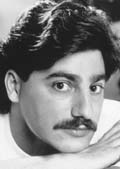 Domingo-protege
Jose Cura looked
like a porn star as Loris but still sings with underwhelming resources.
He sounds kind of like Giacomo Aragall but without the glamorous tone.
He threw himself into the action, however, and played each situation
as if it was Shaw or Shakespeare, not Sardou. The audience devoured
Guleghina and Cura at curtain call time with loud ovations. Carlos Alvarez
was an agreeable De Siriex (he's scheduled for some Met appearances
in the future), while Rosemary Joshua was a pretty, not quite perky
enough Olga. Veteran maestro Edward Downes employed expansive yet firm
tempos. The company used the same La Scala-owned set seen at Lyric Opera
and presumably now en route to the Met. I hope they fix that horribly
loud and squeaky turntable before the opening in New York. Domingo-protege
Jose Cura looked
like a porn star as Loris but still sings with underwhelming resources.
He sounds kind of like Giacomo Aragall but without the glamorous tone.
He threw himself into the action, however, and played each situation
as if it was Shaw or Shakespeare, not Sardou. The audience devoured
Guleghina and Cura at curtain call time with loud ovations. Carlos Alvarez
was an agreeable De Siriex (he's scheduled for some Met appearances
in the future), while Rosemary Joshua was a pretty, not quite perky
enough Olga. Veteran maestro Edward Downes employed expansive yet firm
tempos. The company used the same La Scala-owned set seen at Lyric Opera
and presumably now en route to the Met. I hope they fix that horribly
loud and squeaky turntable before the opening in New York.
Covent Garden's contribution
to the Hindemith centenary was a new Peter Sellars staging of "Mathis
der Mahler". I went not expecting much but was pleasantly surprised
by the depth and integrity of the work. Hindemith's music is what it
is, a challenging synthesis of counterpoint, fugue, folksong and chorale
melody. But the text poses universal questions worthy of serious exploration:
how fully do artists serve a higher power or mankind in their contained
worlds? Is creativity a justifiable endeavor when so many are suffering?
When artists absent themselves from the turmoil of everyday life, have
they become cynical or transfigured? As an actor turned social worker,
I am troubled by these questions. Mathis captures the existential core
of my daily struggle and seems far removed from the dry, academic exercise
I imagined it to be.
The production was
an unadulterated fiasco. Sellars is nothing if not consistent and this
staging was no exception: ugly sets, uglier costumes, amateurish direction
and a mostly irrelevant concept. There were tons of naked scaffolding
all over the stage, some of it adorned with blinking light bulbs. The
costumes were a collection of modern, utilitarian looking uniforms.
The chorus was permanently placed in the boxes adjacent to the stage,
with chorus members wearing their own clothes for the evening.
Sellars is nobody's
fool: his intellect can be discerned among the wreckage. Unfortunately,
he has none of the practical skills necessary to bring his artistic
vision to life. The chorus is any opera is not a nuisance to be banished
from the stage, but a challenge to be solved by directors who know how
to work with operatic conventions. There were constant allusions to
the harshness of modern life (mounds of rotting corpses, urban warfare,
homeless people, etc.) But just when you expected Sellars to make his
hyperrealistic point, he soft pedaled the effect with stylized pretension.
Schwalb and his fellow rebels did not die a horrible death at the hands
of government troops, but melted to the stage floor in a laughable flurry
of charade gestures and arty-farty poses. What little did work, worked
very well. For example, Mathis' final paintings were represented by
a collection of bloodspattered canvases, the symbolic transformation
of suffering into art. As a totality, however, Sellars conception of
the opera as a warning against the bipartisan factionalism now rampant
in American politics left the British audience scratching its collective
head.
Musically, Mathis
operated on a much higher level of achievement. Alan Titus, that boytoy
baritone of yesteryear, has developed into a sort of American Bernd
Weikl, potbelly and all. (Titus has sung Hans Sachs and Barak in Munich
recently, his current base of operations.) He sang the title role with
a convincing mixture of tonal muscularity and interpretive refinement.
Stig Andersen displayed a youthful heldentenor and an attractive Nordic
presence as the Cardinal Albrecht. As Regina, a "breakthrough" role
for both Rothenberger and Lorengar, Christine Oelze touched many hearts
with her sweet lyricism and urgent characterization.
There were many veterans
of the British opera scene in this production, including Robert Tear,
Gwynne Howell and Peter Rose. They all looked like they'd rather have
been in front of the telly watching the infamous Princess Di interview
that aired on BBC that night. Nevertheless, they sang with undiminished
authority. Yvonne Minton, in a cameo appearance as the Countess von
Helfenstein, sounded as fresh as ever. Sadly, her beer-colored satin
pants suit could have garnered some kind of all-time worst award for
costuming (Dunya Ramicova was the designer).
The vocal standout
was Inga Nielsen. As Ursula, Nielsen blew the walls down with a jugendlich
soprano that must be scrumptious as Salome. She proved very adept at
negotiating George Tsypin's set, particularly when the flimsy plank
she climbed onto for her big aria almost snapped under her feet. Esa-Pekka
Salonen's impassioned conducting had people invoking the young Karajan
at intermission. The Royal Opera House Orchestra and Chorus deserved
every accolade.
After the tweedy stuffiness
of Covent Garden, the English National Opera and its environs were a
breath of fresh air. ENO is crawling with queer people! Onstage, backstage,
inside, outside, gay men and lesbians rule. The company makes
its home in the Coliseum, a charming turn-of-the-century music hall
just a stone's throw away from St. Martin in the Fields Church and Trafalgar
Square. More importantly, the Coliseum is nestled between several tres
chic gay bars.
I was always a little
dubious about the stories of fuckin' and suckin' going on in standing
room at Bing's Met, but multiple orgasms (musical and otherwise) are
the order of the day at ENO. At intermission, there were more audience
members at Brief Encounter (a nearby gay disco) than in the Coliseum
lobby. The upper balcony and adjoining standing room area were abuzz
with homo testosterone. There's actually an in-house men's bathroom
you can retire to during the performance for sexual assignations and
still hear the music (several couples took advantage of this convenience
during Turandot). And what better way to begin your night at the opera
than with a cruisy welcome from buff boy ticket takers and ushers?
The gay-positive spirit
isn't just confined to out front: ENO productions revel in queer aesthetics.
David Pountney's staging of Purcell's "The Fairy Queen" didn't just
hint at the love that dare not speak its name--it put it in your face
with a vengeance! Imagine Purcell's masque conceived as a cross between
Wigstock and a Calvin Klein commercial and you get the idea. Drag queens,
leather daddies, hunky ballet dancers, a same-sex wedding--I swear,
the only thing missing was RuPaul as mistress of ceremonies! And why
not? Purcell's disjointed reworking of "A Midsummer Night's Dream",
a work all about loosened inhibitions, needs a unified concept to bind
its disparate elements together. Besides, Purcell's creative bent is
decidedly faggy. I mean, just how many busy tableaux vivants can you
cram into one show?
Pountney's staging
was dazzling in its inventiveness and smoothly integrated use of dance.
After apparently being forced to raid Salvation Army resale shops for
her "Mathis" costumes, Ramicova redeemed herself with Priscilla-style
creations that were colorful and fun to look at. Robert Israel's clever
set pieces contributed to the visual extravaganza.
Musically, the evening
left a lot to be desired. As Titania, Yvonne Kenny's edgy soprano belied
her bel canto reputation, while countertenors Michael Chance and Andrew
Watts made a weak impression vocally. As Oberon, tenor Thomas Randle
looked and sounded like Prince in heat. ENO veteran Richard Van Allan
made the most of his brief appearances as Theseus and Hymen. Nicholas
Kok led his modern-instrument orchestra with little regard for proper
balance between stage and pit, frequently overwhelming his feeble soloists.
The real stars of the evening were the dancers, particularly Simon Rice
as Puck. Dressed in a tiny bra and red tights, Rice tormented the foolish
mortals with commanding relish. Quinny Sacks supplied the winning choreography.
Critics were incensed
by this production and several parents with small children were seen
leaving after the first act. But ENO does not pander to homophobia--at
least, not yet. Let's hope some British Jesse Helms type doesn't control
the purse strings for the arts. ENO is very reliant on government subsidies
for its existence.
The following evening,
ENO unveiled Christopher Alden's magnificent staging of Puccini's "Turandot".
Dramatically, this opera has always seemed a shade false to me but Alden
made a compelling case for Puccini's unfinished swan song. Transplanted
to the early Communist China of the 1930's, this "Turandot" evoked the
totalitarian death machines that flourished unchecked in the first half
of this century. Played out within a claustrophobic arena, Alden's direction
revealed the cruelty and horror of a work too often obscured by pretty,
vacuous chinoiserie. In Act Two, Ping, Pang and Pong were true bureaucrats
of death, compiling statistics at their typewriters as they recalled
Turandot's slain suitors.
Alden sees the pitiless
princess and her henchmen as a metaphor for AIDS and its destruction.
Turandot even looked like a virus at her first entrance: dressed in
purple, she invades the body of the chorus while backlit by a lurid
beam of corpuscular red. The walls of the arena were hung with obituary
photographs of young men who represented Turandot's suitors. As if to
reinforce the connection between death and desire, Alden had the executioner
dispatch the Prince of Persia after simulating intercourse with him.
Turandot herself became a symbol of institutional indifference, blind
to the suffering her apathy creates. Thus, Turandot's tramonta suggested
a day when AIDS is cured. The finale, with the chorus holding up the
photographs of those lost, provided the devastating sense of resolution
missing from Alfano's hollow anthem.
With a thought-provoking
director of Christopher Alden's ability available, I fail to understand
the fascination with charlatans like Peter Sellars. Alden knows what
he's doing and doesn't need to disguise his deficits with visual nonsense.
Alden not only embraced the challenge of a big chorus opera, but had
the ENO ensemble moving like a Bill T. Jones dance troupe. Would someone
please invite Alden back to the States? We need him.
In the title role,
Austrian soprano Sophia Larson riveted attention with her enormous soprano.
Unfortunately, the thrill provided by the power of her Nilsson-like
instrument was undercut by a grating timbre a la Josephine Barstow.
Because she overloads her middle register, Larson's high notes were
sometimes unsteady. Still the size and weight of her voice were impressive
and we will undoubtedly be hearing more from her. Edmund Barham's Calaf
was competently voiced; he appeared to be a kind of English Michael
Sylvester, pushing an essentially lyric voice beyond its compass. Janice
Watson received a heroine's welcome at final curtain calls but it was
undeserved. Her so-so lyric soprano never really soared in the upper
register and her interpretation was nothing special, either. David Atherton's
conducting spotlighted the elements of Bartok, Schoenberg and Stravinsky
in the score.
Well, that wraps up
Enzo's exploits abroad. I loved my first trip to jolly old England and
encourage all you virgin queens to see it for yourselves. Covent Garden
was absolutely fabulous, but ENO's queer-friendly milieu made Il Bordello's
maiden voyage truly memorable.
|